What is the work of explaining and modeling content?
Explaining and modeling are practices for making a wide variety of topics, academic practices, and strategies explicit to students. Teachers determine when explaining or modeling can help to make explicit content and practices that often remain tacit or invisible. Teachers might use simple explanations when working with straightforward content. They might choose modeling, which includes verbal explanation as well as thinking aloud and demonstrating when sharing the metacognitive process, to provide greater access to students about strategies and practices.
How does explaining and modeling content advance justice?
Explaining and modeling content makes visible strategies, processes, and practices that may remain hidden to some students. Access to the kinds of knowledge most valued by and represented in traditional school settings is differentially distributed across lines of race and class. Making this content explicit by explaining, demonstrating, and modeling is critical to ensuring access to these skills across a range of learners. However, modeling can also convey low expectations of students and impede students’ opportunities to make sense of content themselves. Teachers make judgments about whether and when to model specific content or practices, and ensure that students are supported and also have opportunities to think on their own.
What are the elements of the practice?
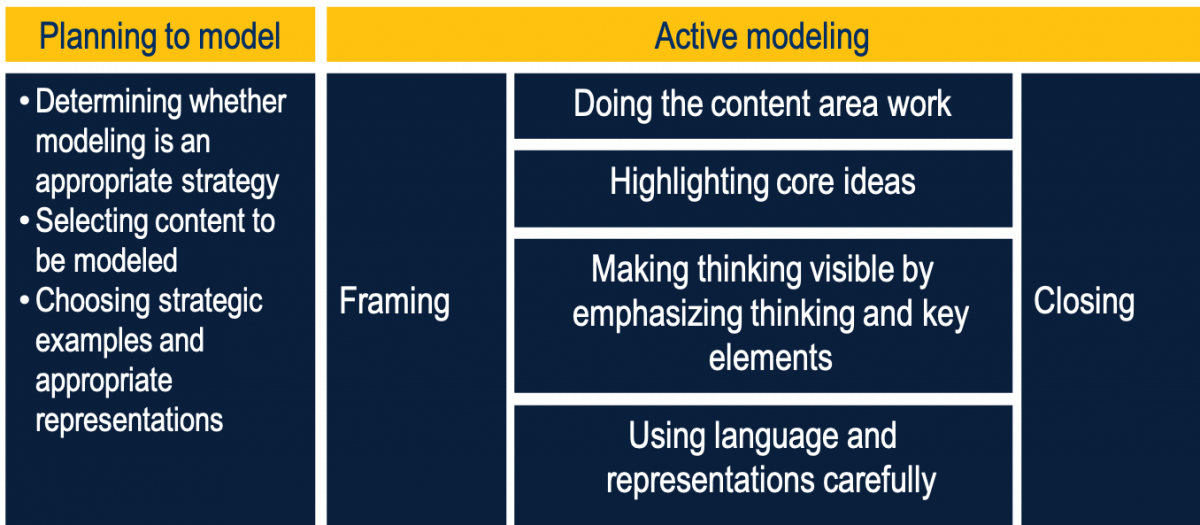
The diagram below breaks down work that teachers do when they are explaining and modeling content. This breakdown, or decomposition, helps teacher educators to break down the practice into a set of parts that can be observed and practiced.
